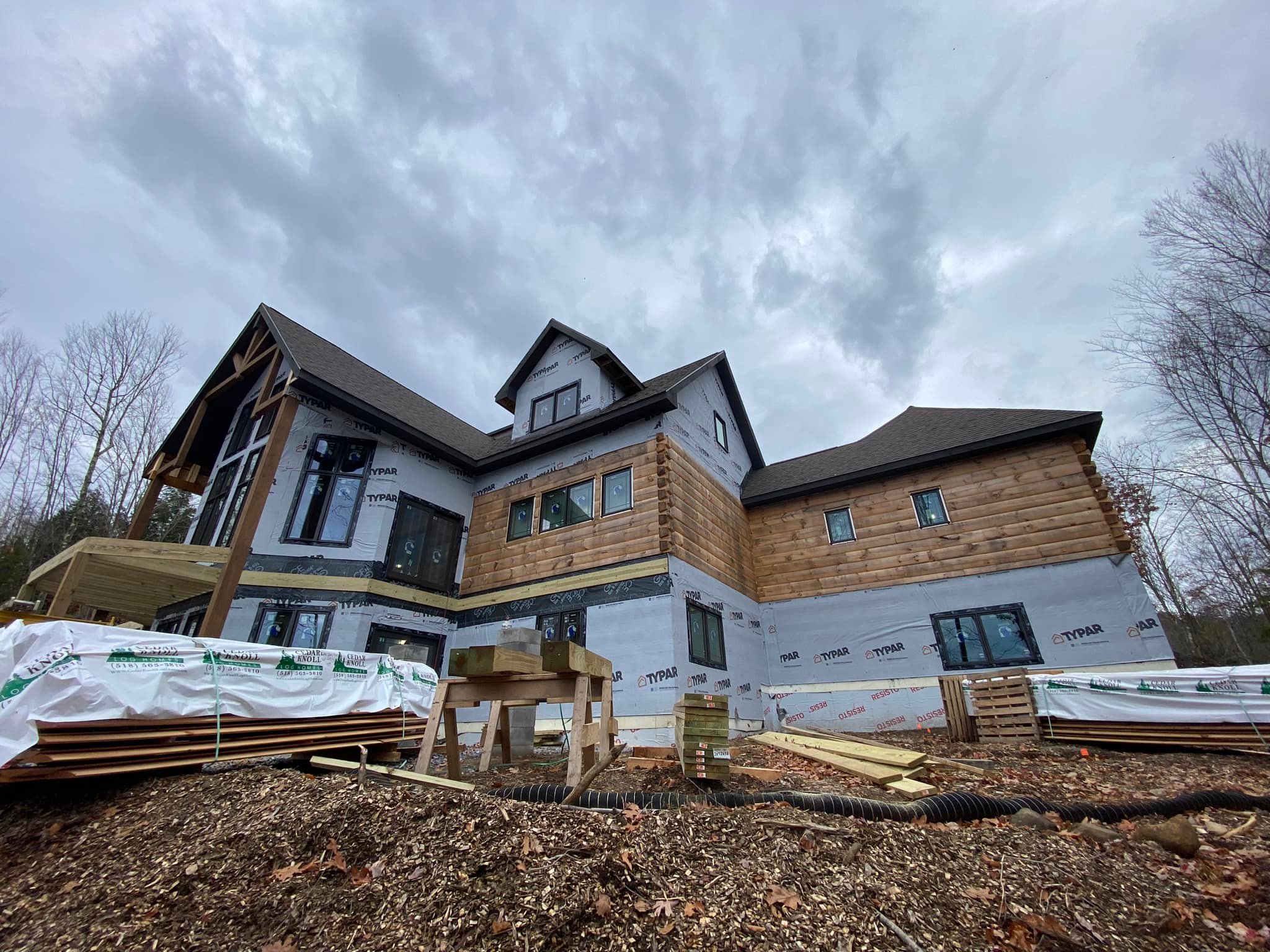
Prevent Log Home Pests And Insects
Protect Your Log Home From The Start
At Cedar Knoll, we offer something that many log home companies do not: log treatments and pre-staining, so your pre-cut kit arrives ready to build AND finished.
One of the treatments we offer as a pre-build application is a borate-glycol wood preservative (aka “the ultimate protection against insects and wood rot for your log home”).
The product we use is Shell-Guard from PermaChink®. This proprietary blend combines the well-known effectiveness of borates with a glycol system that increases the penetration into the wood to enhance the action of the borate. Not only is it colorless and odorless, but the glycols they use are the same type found in many food and skin care products.
But the best thing about purchasing this treatment with your weather-tight kit is that it’s a one-and-done application. As log as the wood is maintained with a quality water-resistant stain, such as the Ultra 7 that we pre-stain with, our in-house application will last for the life of your home.
Common Pests That Our Treatment Works Against
Once in the wood, our product works to kill those insects that eat wood, insects that bore into wood, and it also kills the types of fungi that are responsible for rot and decay. Here’s a closer look at what we’re protecting your home from:
Carpenter Bees

BACKGROUND Carpenter bees nest in excavated wooden tunnels.
APPEARANCE Carpenter bees are robust, heavy-bodied bees that range three-quarters inch to one inch in length. The carpenter bee can be identified by having bright yellow, orange or white hairs on the thorax and shiny black abdomen. The male carpenter bee can be identified by having white markings on the head.

SIGNS OF INFESTATION
- Stains caused around the entrance hole
- A buzzing or burrowing sound
- These insects bore one-half inch wide holes that appear to be perfectly round on exterior wooden surfaces
- Fine sawdust caused by the excavating
Carpenter Ants
BACKGROUND Carpenter ants do not eat wood, but they tunnel and chew through it to create nests.
APPEARANCE Carpenter ants vary in size and can be anywhere from ½” to ⅝” long. While black carpenter ants are common, you may also find a combination of black and red, red, or brown.

SIGNS OF INFESTATION
- A rustling sound in the nesting area
- Piles of fine sawdust
- Appearance of winged male

Termites

BACKGROUND There are a wide variety of termite subspecies, but Drywood, Dampwood, and Subterranean are the most common concerns log home owners have. Mostly a concern is sunny, warm areas. They both make colonies in wood and eat wood to survive.

APPEARANCE Ranging from 1/4 inch to 1 inch long, adults have a thick oval-shaped waist, six short legs, and equal length wings. They’re usually cream-white or light brown in color.
SIGNS OF INFESTATION
- Discarded wings, especially near light sources
- Droppings (or “frass”), which look like small mounds of tiny pellets
Beetles
BACKGROUND There are a few subspecies in the beetle genus that are log home owners in the United States keep an eye out for: powder-post beetles, old house borers, and carpenter beetles.
APPEARANCE Most range from 5/8 to 1 inch in length and are brownish black in color. Old house borers may have gray hairs on the head and forepart of the body and a shiny raised bump on each side just behind the head.

SIGNS OF INFESTATION
- Ragged, oval-shaped exit holes that are about 1/4 to 3/8 of an inch in diameter
- Droppings (or “frass”), which is sawdust-like and is often outside or near the colony’s exit hole
- Clicking or “rasping” sounds
Log Home Learnings
For more expert tips and insider opinions, be sure to follow our Log Blog. We’re always posting new information that you won’t find anywhere else!