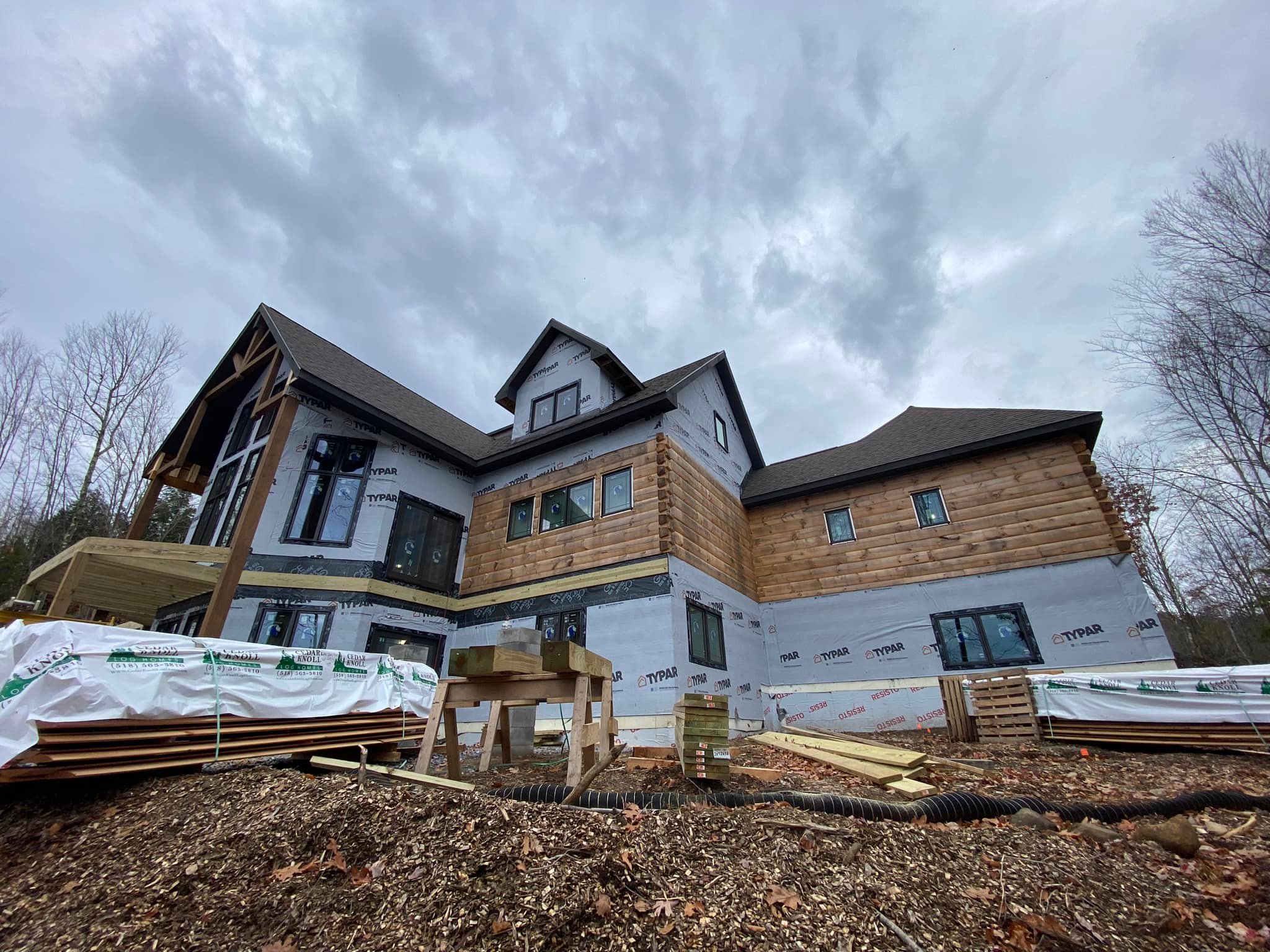
Stick-Built vs. Full Log Homes: The Hidden Costs You Need to Know
When considering new home construction, the debate between stick-built and full log homes often centers on initial costs and aesthetics. However, understanding the long-term financial implications is crucial. This comprehensive guide reveals why stick-built homes might end up being a more expensive investment over time compared to full log homes. Discover the hidden costs and ongoing expenses that could make a full log home the smarter choice for your future.

Stick-Built Homes: The Hidden Costs
1. Comparable Cost To Build
Something you might not see if you aren’t comparing receipts is that the cost of a stick build vs. a full log home are approximately the same at the end of the day. How is that possible? Let’s break down a recent project we saw priced out:
Project Overview: 1,300 sq ft home with a walk-out basement.
Full Log: 8×8 pine, $102,000 weather-tight kit with a 3 day log stack time with an all-in-one wall system.
Stick Build: 2×6 framed wall, $75-80,000 for equivalent framed package. Just the framing might take 2-3 days, but then you have 5 more steps to get to the same level of completion: framing, exterior sheathing, wrapping, siding, purchase and install of insulation, finish the inside wall (v-joint, sheetrock, etc.). This adds another 3 weeks (~$1,000 a day in labor) to your build time and overall budget.
In the end, you might only save $10-15k on the build just to end up with an inferior product that 1. takes longer to build, 2. results in more frequent expenses, and 3. has a lower resale value.
2. Higher YoY Maintenance Expenses
While stick-built homes often have lower initial construction costs—ranging from $100 to $150 per square foot (National Association of Home Builders, 2023)—they can come with significant long-term maintenance expenses. Stick-built homes typically use materials like wood framing and siding, which require regular upkeep.
- Stick-Built Maintenance Costs: HomeAdvisor estimates that homeowners spend between $500 and $1,500 every single year on maintaining moderate-sized stick-built homes. This includes expenses for painting, siding repairs, and other minor fixes (HomeAdvisor, 2024).
- Labor estimates are around $4,500.
- Full Log Maintenance Costs: End sealer and stain maintenance every 5-8 years for best results. Perma-Chink® costs about $500-1,600 per 20 gallons.
- Labor estimates are around $4,500.
- Stick-Built Pest Control Costs (New Builds): Stick-built homes have more layers, meaning there are more openings for pests to get into. Common infestations including mice, rats, termites and carpenter ants. According to the Journal of Economic Entomology, annual pest control services for stick-built homes can range from $300 to $1,000 (Journal of Economic Entomology, 2023).
- Full Log Pest Control Costs (New Builds): So long as you keep shrubbery away from the exterior and perform shell maintenance every 5-8 years, a regular ol’ cleaning (weekly dusting, crack-filling if ever necessary) is typically enough of a routine.
2. Energy Inefficiency
Energy efficiency is another area where stick-built homes can incur higher costs. Traditional stick-built homes often use conventional insulation materials like fiberglass or foam. Over time, these materials can settle or degrade, leading to increased heating and cooling expenses.
- Increased Utility Bills: The U.S. Department of Energy reports that stick-built homes with less effective insulation can see energy bills rise by 10% to 20% compared to homes with better insulation (DOE, 2024).
- Thermal Mass of Full Logs: Full logs rise above the rest with minimal utility costs. See the science that keeps logs as nature’s best insulator here.

Full Log Homes: The Cost-Effective Choice
1. Lower Long-Term Maintenance Costs
Full log homes, despite their higher initial construction costs—typically between $150 and $200 per square foot (NAHB, 2023)—often result in lower ongoing maintenance expenses. Regular treatments with sealants and preservatives every 2 to 5 years can prevent issues related to moisture and pests.
- Maintenance Cost Comparison: While sealant treatments can cost between $1,000 and $5,000, full log homes often require less frequent repairs and upkeep overall (American Log Builders Association, 2024).
- Debunk full log maintenance myths here.
2. Energy Efficiency Benefits
Full log homes offer excellent thermal mass, which helps in regulating indoor temperatures. This natural insulation can lead to lower energy bills over time.
- Energy Savings: Log homes generally offer better energy efficiency compared to stick-built homes, potentially reducing heating and cooling costs by 10% to 30% (Log Home Living, 2023).
Durability and Resale Value
1. Longevity and Durability
Full log homes are known for their durability and longevity. With proper maintenance, they can last for generations. Stick-built homes, on the other hand, may face issues related to rotting, warping, and deterioration over time, leading to higher repair costs.
- Long-Term Stability: According to the National Association of Realtors, stick-built homes may incur more frequent major repairs compared to well-maintained log homes (NAR, 2023).
2. Resale Value
The unique charm of full log homes can attract buyers willing to pay a premium. While stick-built homes are more common, their potential for higher long-term costs and depreciation might impact their resale value.
- Market Appeal: Well-maintained log homes can command higher resale values and attract niche buyers, potentially offering better returns on investment (NAR, 2023).
- Read about one of our first-hand success stories here.

Which Home is the Better Investment?
Choosing between a stick-built and a full log home involves more than just considering the initial cost. Stick-built homes, while initially cheaper, often incur higher long-term maintenance and energy costs. In contrast, full log homes, despite a higher upfront price, can be more cost-effective over time due to lower maintenance and better energy efficiency.
For homeowners looking to make a sound financial investment, understanding these hidden costs is crucial. Full log homes often prove to be the more economical choice in the long run, providing both durability and lower ongoing expenses.
By considering these factors, you can make a more informed decision about your next home construction project. Explore the benefits of each option and choose the one that best aligns with your long-term financial goals. Read our article on log home financing for more information.
Sources
National Association of Home Builders (NAHB) Cost of Construction Data
American Log Builders Association (ALBA) Log Home Maintenance Information
U.S. Department of Energy (DOE) Energy Efficiency and Insulation
National Association of Realtors (NAR) Real Estate Market Trends